
VacDry Low-Temperature Vacuum Dryer
VacDry: Low-Temperature Vacuum Dryer for Delicate Clothes
Team: David Li Yongye Hu Eric Pham Alex Li Shaojie Wang Show all
Mechatronics Engineer
Hit 20-minute drying at 40 C and 50 dBA; validated through 10 continuous 1-hour operation cycles with no pressure loss.
- SolidWorks
- Ansys Fluent
- FMEA
- 3D printing
- Vacuum systems
Hardest engineering problem: A rotating drive-shaft penetration kept breaking vacuum reliability until the failure mode was removed with a magnetically coupled drive.
Overview
VacDry was a self-initiated hardware product prototype targeting a specific gap in home drying: delicate fabrics are damaged by heat, conventional cycles are slow, and apartment-friendly machines need lower noise. The target spec was deliberately concrete: dry at 40 C, finish in about 20 minutes, and stay around 50 dBA.
My Role
I led mechanical design and prototype development from concept to testable hardware. My work covered CAD, packaging, vacuum chamber design, CFD-supported operating assumptions, FMEA-driven reliability improvements, fabrication, and subsystem integration across pump, heater, sensor, and drive mechanisms.
Key Results
- Built a working prototype that reached the target 20-minute drying cycle at 40 C and 50 dBA.
- Validated reliability through 10 continuous 1-hour operation cycles with no pressure loss or failures.
- Used physical experiments to tune drying curves and shorten drying time by about 30% from earlier settings.
- Converted FMEA findings into concrete reliability upgrades for a consumer-facing safety case.
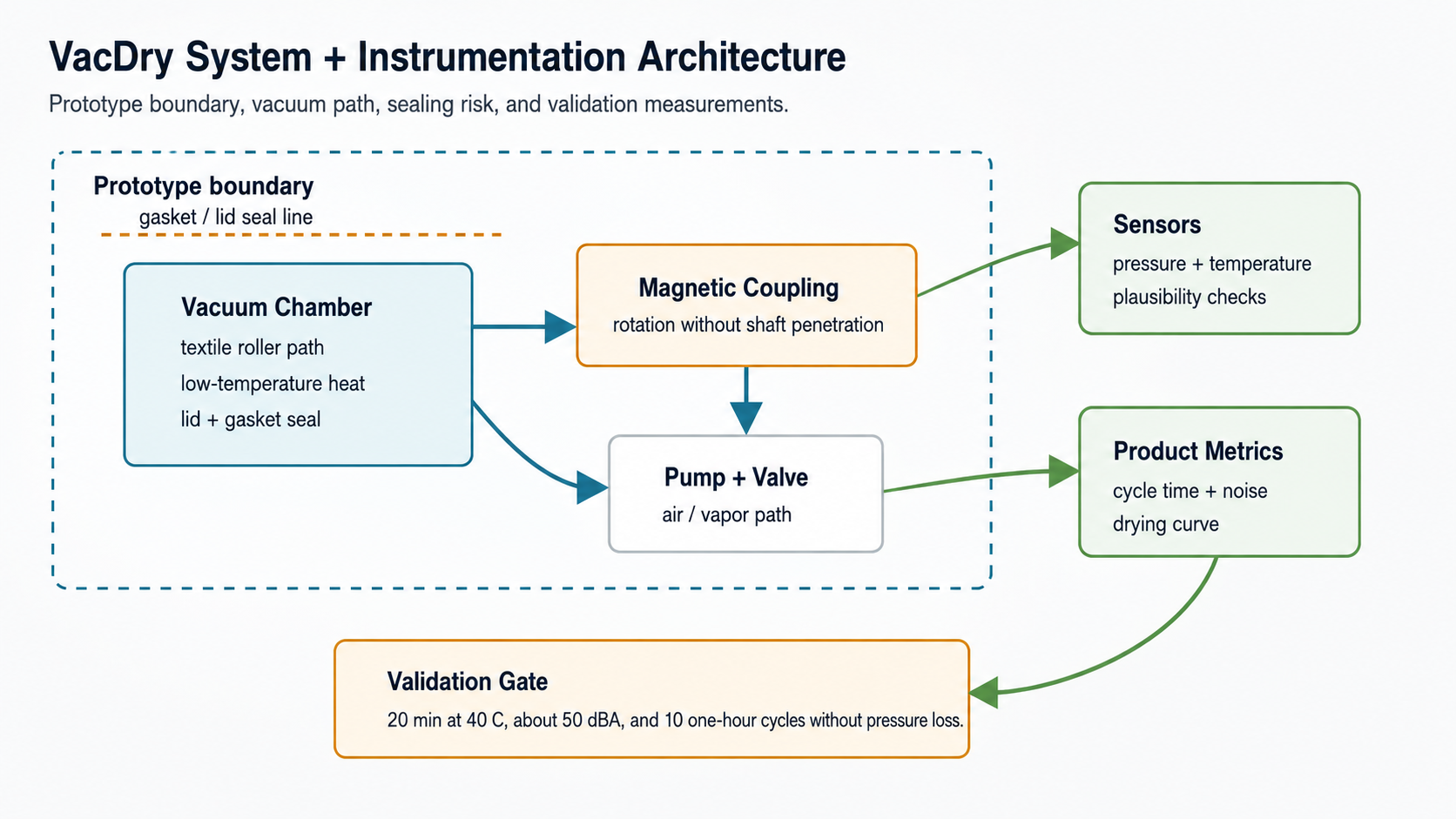
System Architecture
Drying System
Vacuum chamber, low-temperature heat source, air/vapor management, sensors, and rotating textile support.
Reliability System
Pressure hold, gasket integrity, sensor plausibility, thermal redundancy, and user-facing safety risks.
Validation System
CFD assumptions were checked against physical drying curves and repeated one-hour operation cycles.
Instrumentation / Reliability Architecture
VacDry was less code-centered than the robotics projects, so the architecture emphasis is on instrumentation and validation rather than a large firmware stack. The publishable story is how pressure, temperature, noise, cycle time, and drying performance were measured together so the prototype could be judged as a consumer machine rather than a lab mechanism.
Flow boundary: the page treats pump, heater, chamber seal, textile rotation, and sensors as a prototype validation system. It does not claim a certified or production-ready appliance.
Control / Simulation Methodology
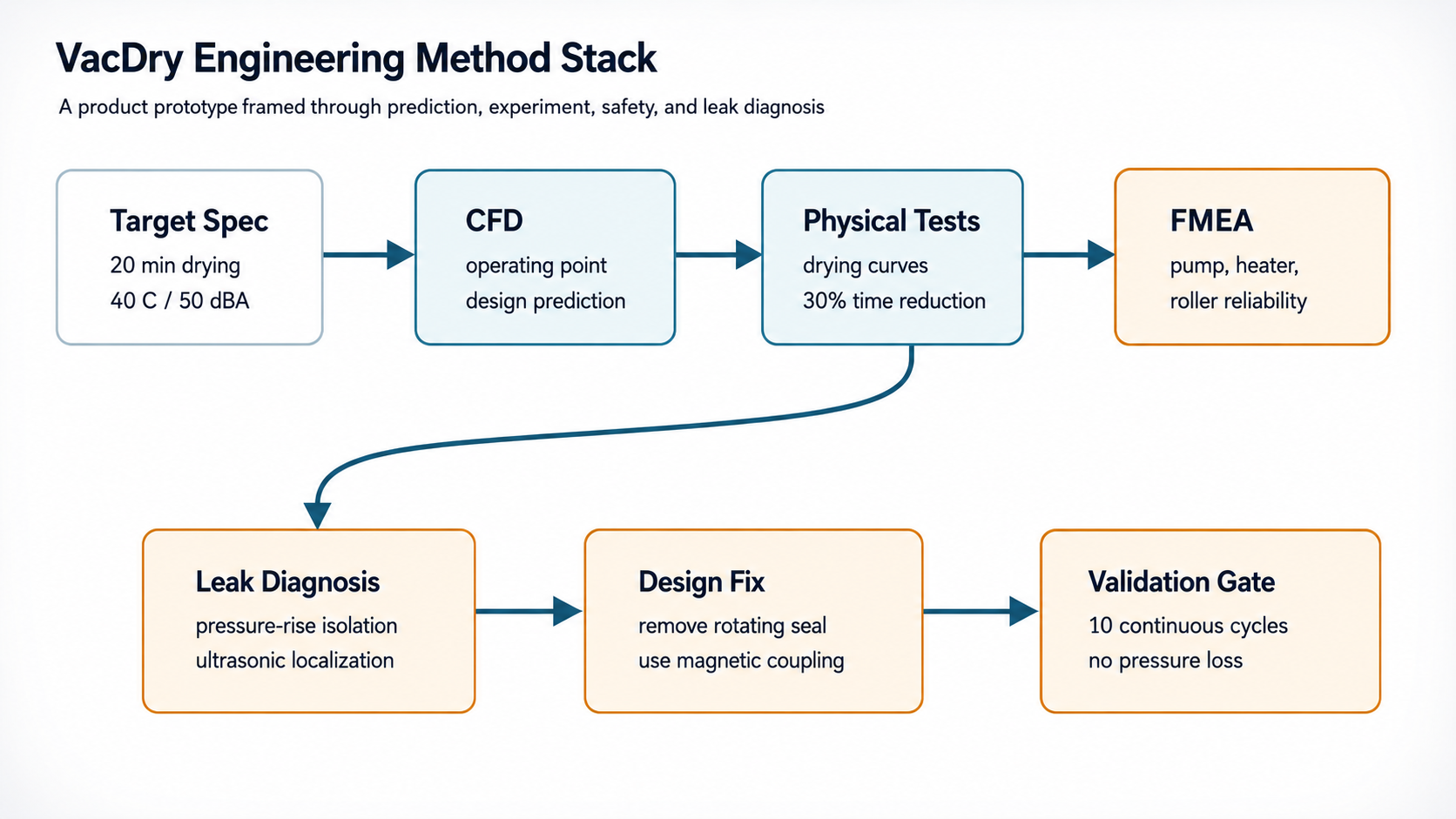
The method stack was intentionally layered. CFD gave a low-cost way to explore operating parameters before fabrication, experiments closed the gap between simulation and real drying behavior, and FMEA translated engineering risks into a reliability story that would matter for a consumer product.
| Method | What it answered | Why it mattered |
|---|---|---|
| CFD | Expected flow and operating behavior before expensive iteration. | Reduced blind mechanical redesign. |
| Physical tests | Actual drying curve and pressure behavior. | Closed the model-to-prototype gap. |
| FMEA | Consumer-facing failure modes across pump, heater, and roller subsystems. | Turned safety into design requirements. |
Validation & Debugging
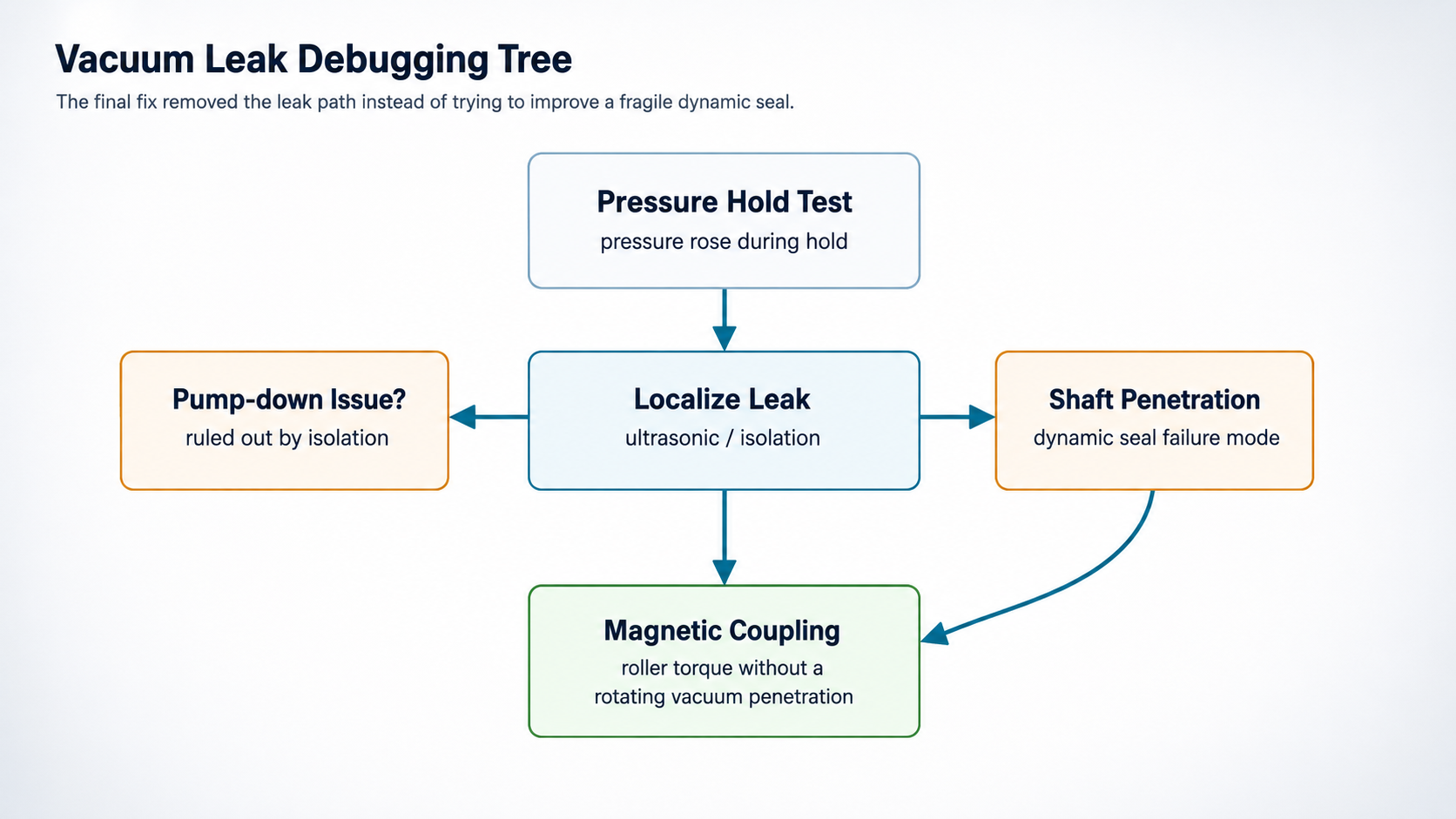
The hardest issue was a recurring vacuum leak. I diagnosed it with a pressure-rise isolation process and ultrasonic localization, then traced the root cause to the rotating drive-shaft penetration. Instead of trying to improve the dynamic seal, I replaced the failure mode with a magnetically coupled drive so the rotating shaft no longer penetrated the vacuum chamber.
| Validation gate | Measurement | Public result |
|---|---|---|
| Drying target | Cycle time and operating temperature. | 20-minute drying at 40 C. |
| Noise target | Acoustic level during operation. | About 50 dBA. |
| Pressure reliability | Repeated one-hour operation cycles. | 10 continuous cycles with no pressure loss or failure. |
| Risk control | FMEA findings across pump, heater, and rolling subsystems. | Pressure alarm, gasket improvement, sensor plausibility checks, and redundant temperature sensing. |
The final validation gate was not only a single successful dry cycle: the prototype ran 10 continuous one-hour operation cycles without pressure loss or failure.
What I Would Improve
I would make the next version more instrumented from day one: pressure, humidity, textile mass, chamber temperature, and acoustic readings should be logged together so each design change has a measured effect on the product target. I would also separate the vacuum sealing test rig from the drying rig so leak fixes can be isolated before the full machine is assembled.