
ROBOCON Multi-Robot System
ROBOCON Multi-Robot System for Retrieval and Targeting Challenge
Team: Jiacheng Li Yongye Hu Zhixiong Zhang Kehao Chen Guanshao Lin Junbo Shan Minkang Gong Chao Liu Xingzhi Li Yeying Wang Show all
Advised by: Professor Yu Hou
Integrated Mechanical Engineer
Reached the Top-16 finalist stage at ROBOCON 2023 out of 80 competing teams.
- CAD
- CNC machining
- STM32F407
- CAN bus
- Pneumatics
Hardest engineering problem: The system had to stay competition-reliable while CAD, CNC fabrication, pneumatics, embedded controls, and field failures were all changing under deadline pressure.
Overview
This ROBOCON system combined three competition robots for object retrieval, launching, and speed-focused traversal. The work sat at the boundary between mechanical design, manufacturing, embedded controls, and field reliability under a fixed competition schedule.
My Role
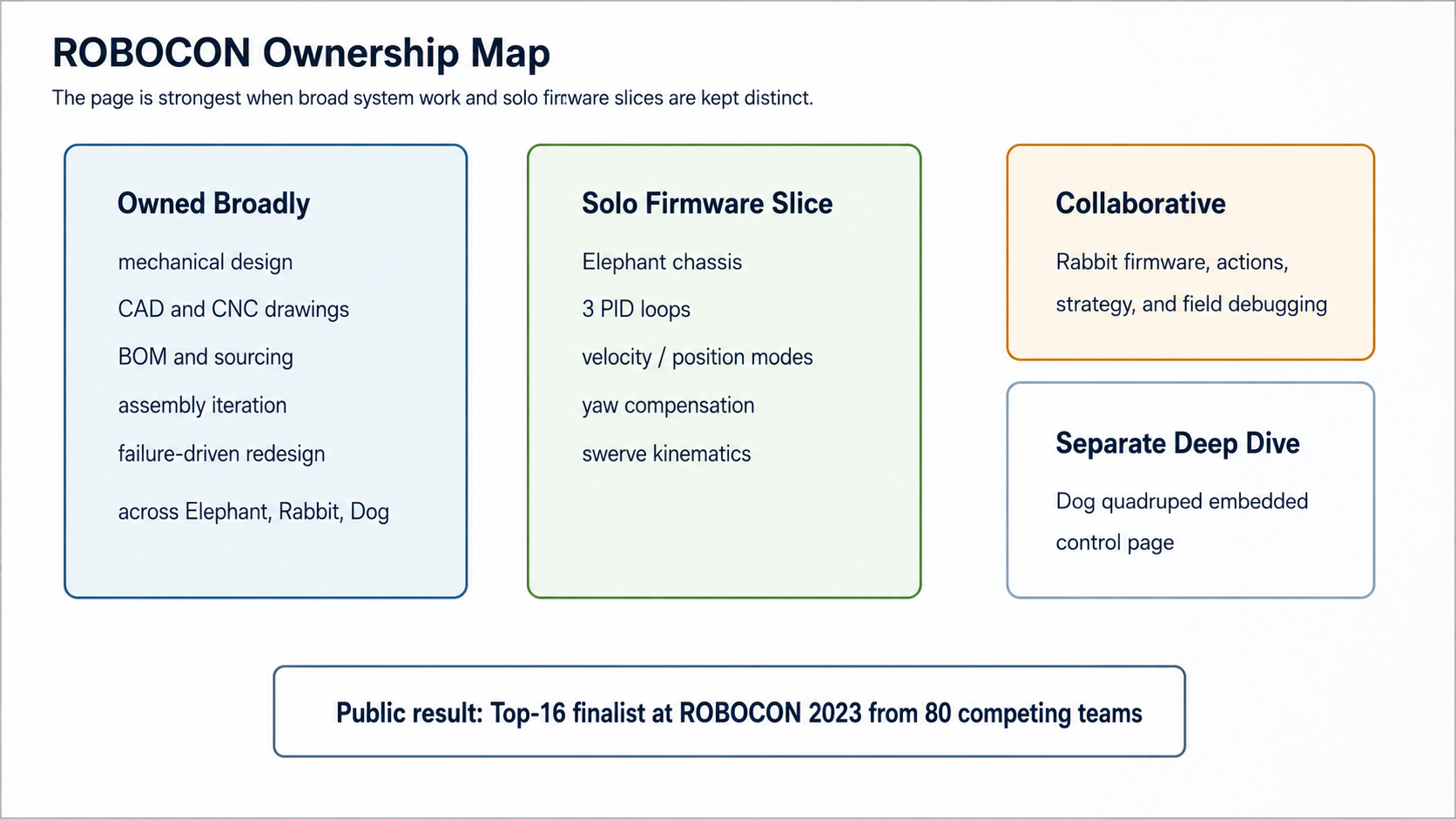
I owned the mechanical side across all three robots: CAD, CNC drawings, BOM planning, supplier coordination, assembly, and failure-driven redesign. On firmware, I wrote the Elephant 3-PID dual-mode chassis controller solo; the remaining firmware was mixed-authorship with teammates, so I describe that part as collaboration rather than sole ownership.
Key Results
- Reached the Top-16 finalist stage at ROBOCON 2023 from a field of 80 teams.
- Selected a 3-wheel swerve architecture for Elephant, prioritizing top-end linear speed and gaining 33% over the prior chassis.
- Built a competition-ready mechanical system across three robots using CAD, CNC machining, FDM printing, pneumatics, and iterative assembly testing.
- Improved public-match reliability after repeated development failures, including fastening changes that addressed thread-stripping under impact loads.
3D Model Overview
System Architecture
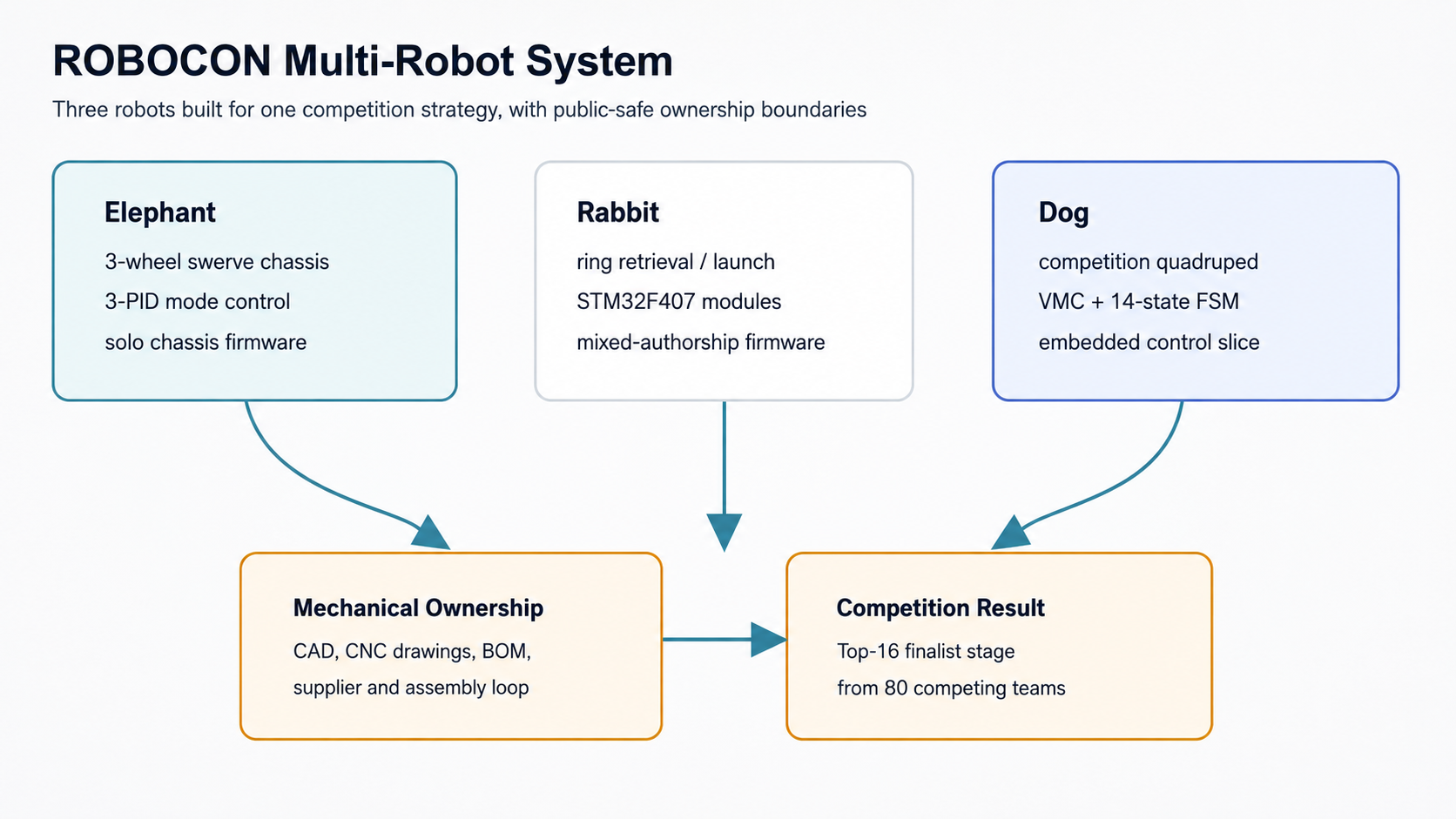
Elephant
High-speed 3-wheel swerve chassis with steering, drive, slip-ring packaging, and a dual-mode chassis controller.
Rabbit
Retrieval and launch robot with STM32F407 modules, motor control, pneumatic actions, and teammate-shared firmware.
Dog
Quadruped obstacle robot, now described separately as its own deeper embedded-control case.
Software / Firmware Architecture
| Subsystem | Architecture | Ownership boundary |
|---|---|---|
| Elephant chassis | Three PID loops for X, Y, and yaw, with velocity/position modes and yaw compensation. | Solo-authored chassis controller. |
| Rabbit actions | STM32F407 firmware integrating CAN motor control, UART, launcher, lift, and clip actions. | Collaborative firmware work with teammates. |
| Team strategy | Robot roles, field timing, and match behavior were tuned as a multi-robot system. | Shared strategy and field debugging. |
Control / Simulation Methodology
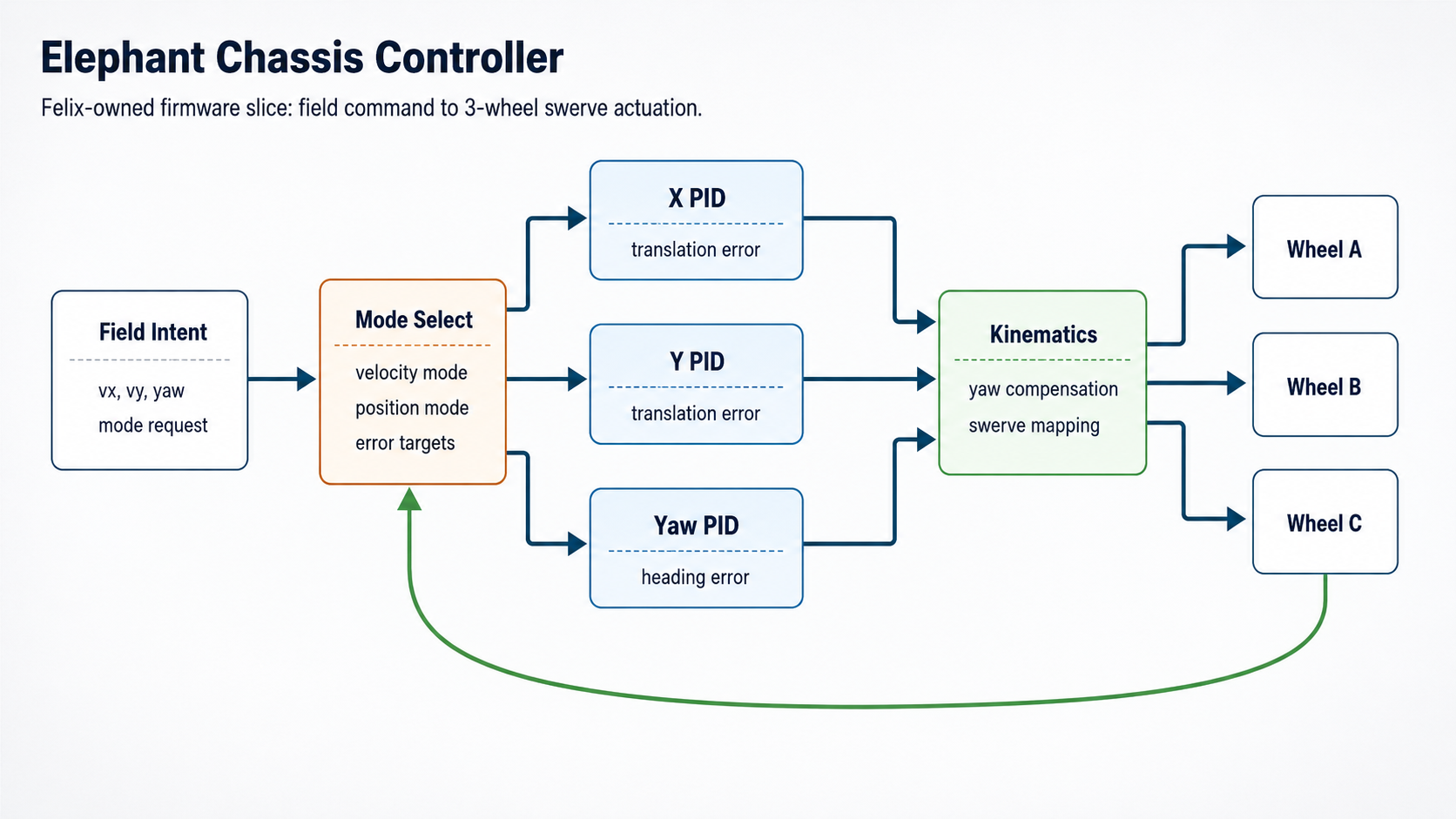
The Elephant wheel architecture was the load-bearing design choice. A 3-wheel swerve drive added complexity through steering motors, drive motors, slip rings, belt steering, and continuous rotation packaging, but the speed gain mattered more than the extra build burden for the competition objective.
The controller design matched that mechanical choice: PID loops handled translational and yaw error while inverse kinematics and yaw compensation converted field-level intent into chassis motion. The portfolio should show this as a practical embedded-control architecture, not as a black-box robot.
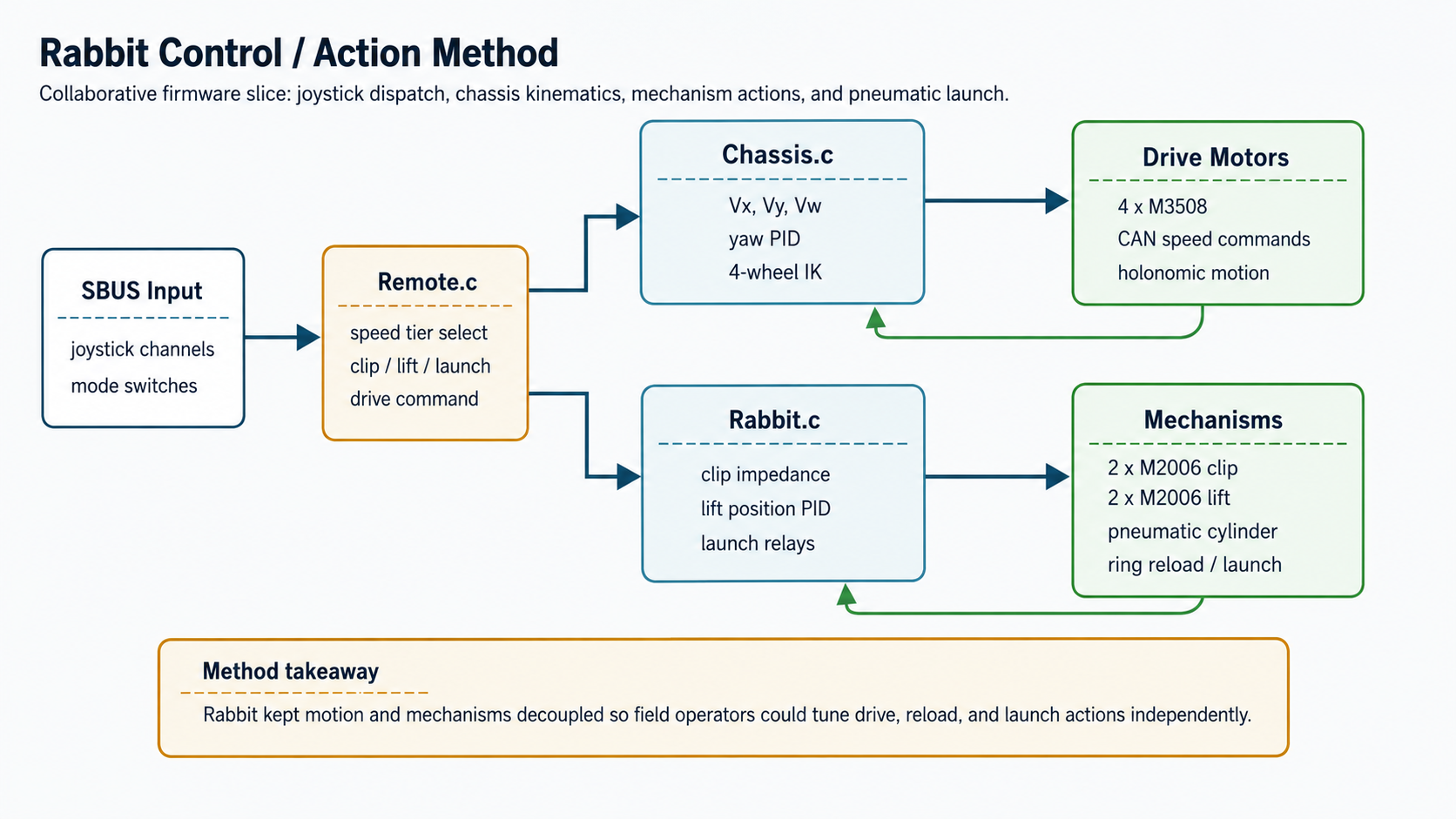
Rabbit had a different control problem: it needed to coordinate chassis movement with ring capture, lift/reload, and pneumatic launch actions. The firmware separated joystick/action dispatch from chassis kinematics and mechanism commands, so the team could tune drive behavior, clip force, lift increments, and launch timing without turning the robot into one monolithic routine.
| Workstream | How to read the claim | Evidence direction |
|---|---|---|
| Mechanical program | Felix-owned CAD, CNC drawings, BOM planning, sourcing, assembly, and failure-driven redesign across the three robots. | Use this as the broad system-integration claim. |
| Elephant chassis controller | Solo-authored 3-PID chassis controller with yaw compensation and inverse-kinematics conversion. | Use as the strongest firmware slice on this page. |
| Rabbit and shared firmware | Collaborative STM32F407 firmware combining SBUS dispatch, 4-wheel chassis kinematics, CAN motor control, clip/lift routines, and pneumatic launch relays. | Use as a concrete method slice, while keeping authorship collaborative. |
| Dog quadruped | Separate deep embedded-control case. | Link readers to the Dog page for details. |
Validation & Debugging
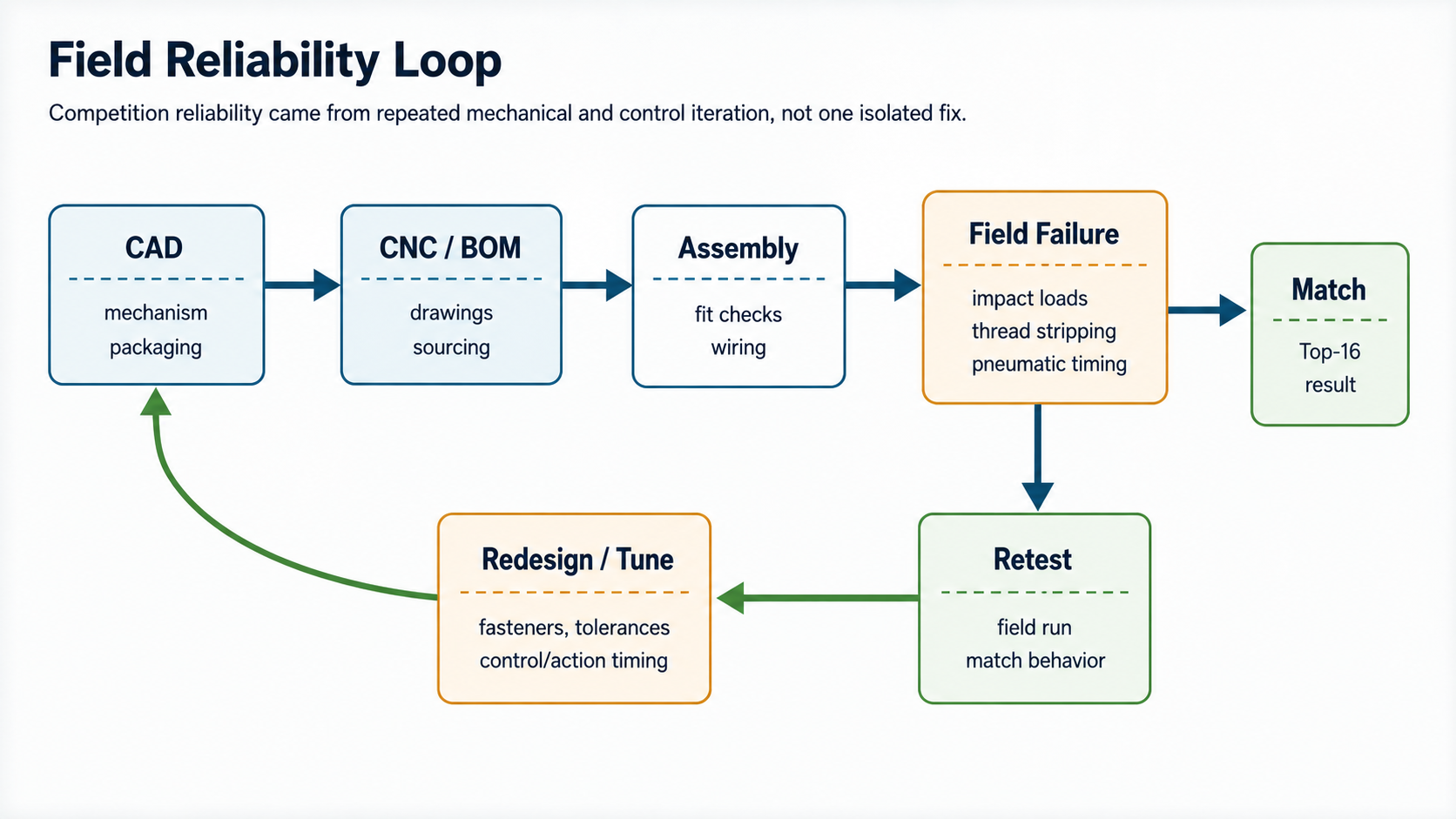
Validation happened through field iteration, public-match reliability checks, and repeated mechanical failures. The most useful debugging pattern was not one isolated algorithm fix, but the loop from CAD to CNC drawing to assembly to impact failure to fastening redesign.
The system result was Top-16 at ROBOCON 2023 from 80 teams. That result anchors the mechanical and firmware work without overstating sole ownership of every subsystem.
What I Would Improve
In hindsight, I would split the page into a system overview plus linked robot-specific deep dives only after the Elephant and Rabbit casefiles are equally mature. I would also take more solo firmware ownership earlier, because the mechanical system was already strong and the next growth area was embedded-control fluency.