
Relevel Robotics Dual-Arm Platform
Relevel Robotics: Dual-Arm Compliant-Control Platform
Founder / Product Engineer
Reached pilot-stage integrated capability; reduced real-hardware oscillation by about 35% through sim-to-real control tuning.
- ROS2
- Drake
- Jetson Orin
- AprilTag
- Impedance control
Hardest engineering problem: Low-rate, noisy perception updates could destabilize contact-rich motion unless they were decoupled from the fast impedance-control loop.
Overview
Relevel Robotics focused on a dual-arm robotic platform for contact-rich industrial manipulation: polishing, bimanual assembly, visual-servoing handover, and contact-aware grasping. I present this as a public-safe control and integration case, not as a commercial disclosure page. The useful engineering story is how perception, real-time control, communication timing, and physical compliance had to be separated into rates the hardware could actually tolerate.
Public-safe boundary: this page avoids customer details, private deployment counts, sensitive dataset claims, and teammate-led work that is not safe to publish without review.
My Role
I founded the company and worked as product engineer across control and system integration. My direct public-safe ownership included hardware bringup, low-level drivers, ROS2 dual-arm coordination, real-time communication tuning, perception-control interfaces, and controller tuning on physical hardware.
Key Results
- Built a working integrated dual-arm platform with validated capabilities across polishing, bimanual manipulation, visual servoing, and tactile/contact-aware experiments.
- Developed a ROS2 dual-arm stack running coordinated control at 100 Hz.
- Reduced real-hardware oscillation by about 35% after identifying latency, sensor noise, compliance, and unmodeled friction as sim-to-real causes.
- Integrated 30 Hz AprilTag pose updates with a 1 kHz impedance-control loop for robust visual-servoing behavior under imperfect vision timing.
System Architecture
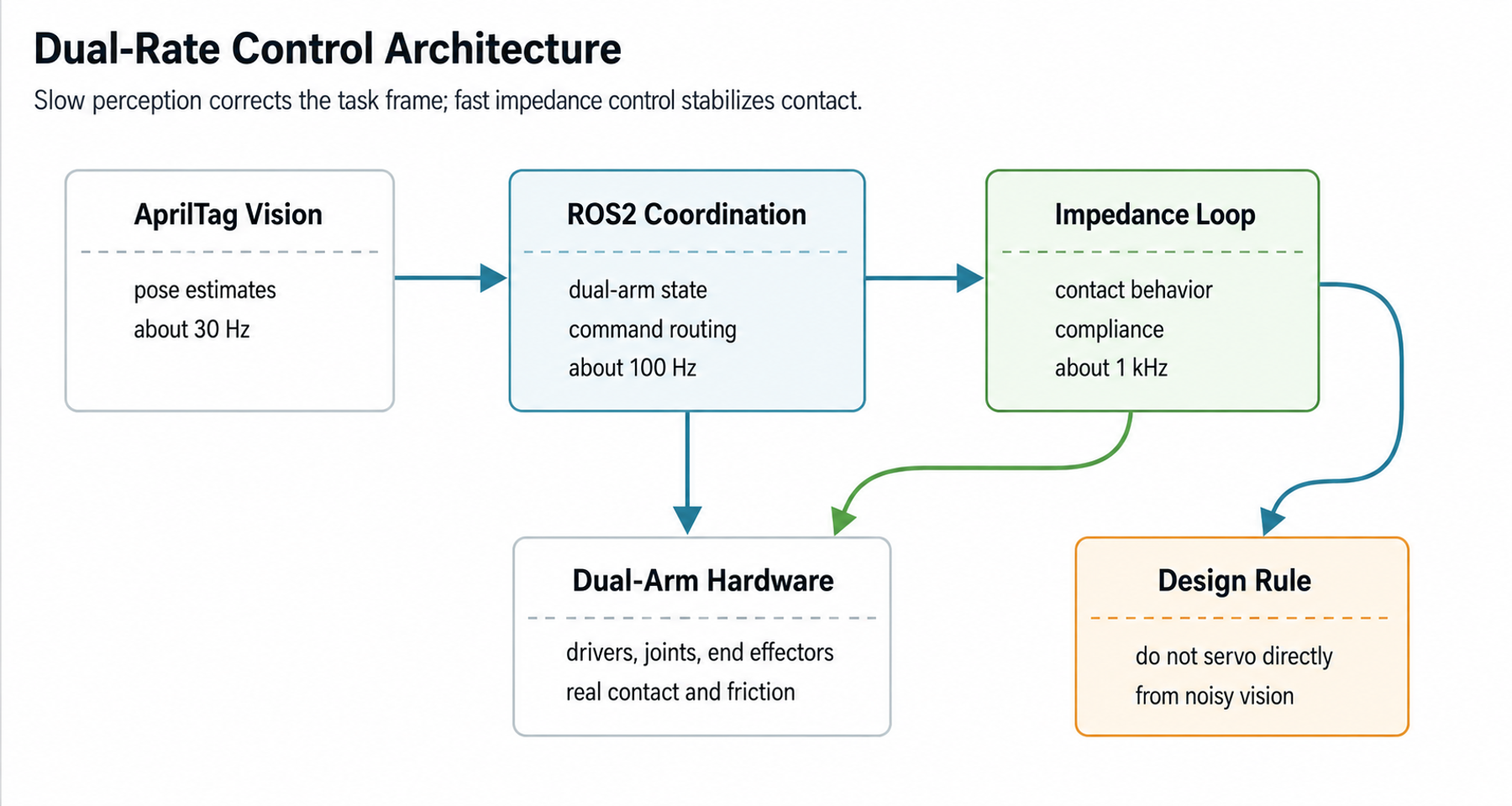
Robot Platform
Dual-arm hardware, end-effector integration, driver bringup, and real-time command interfaces for contact-rich manipulation.
Control Layer
ROS2 coordination at 100 Hz with a 1 kHz impedance-control loop as the fast stabilizing layer.
Perception Layer
AprilTag pose estimates at about 30 Hz used as slower correction signals rather than direct servo commands.
Software / Firmware Architecture
| Layer | Responsibility | Reason it mattered |
|---|---|---|
| Low-level drivers | Hardware bringup, actuator communication, timing checks, and command plumbing. | Made real hardware behavior visible before high-level tasks were tuned. |
| ROS2 coordination | Dual-arm state, command routing, task sequencing, and integration with perception. | Kept bimanual coordination inspectable and repeatable. |
| Control interface | Filtered slower perception updates into a fast compliant-control loop. | Prevented noisy or delayed visual estimates from becoming direct high-rate actuator noise. |
Control Methodology
The most important architecture decision was rate decoupling. A vision loop running at about 30 Hz cannot be treated like a clean high-rate servo signal, especially under occlusion, dropped detections, or delayed updates. I used 1 kHz impedance control as the fast inner loop and treated AprilTag pose as a slower correction signal. That made the controller robust to imperfect vision timing instead of letting every pose update jerk the robot.
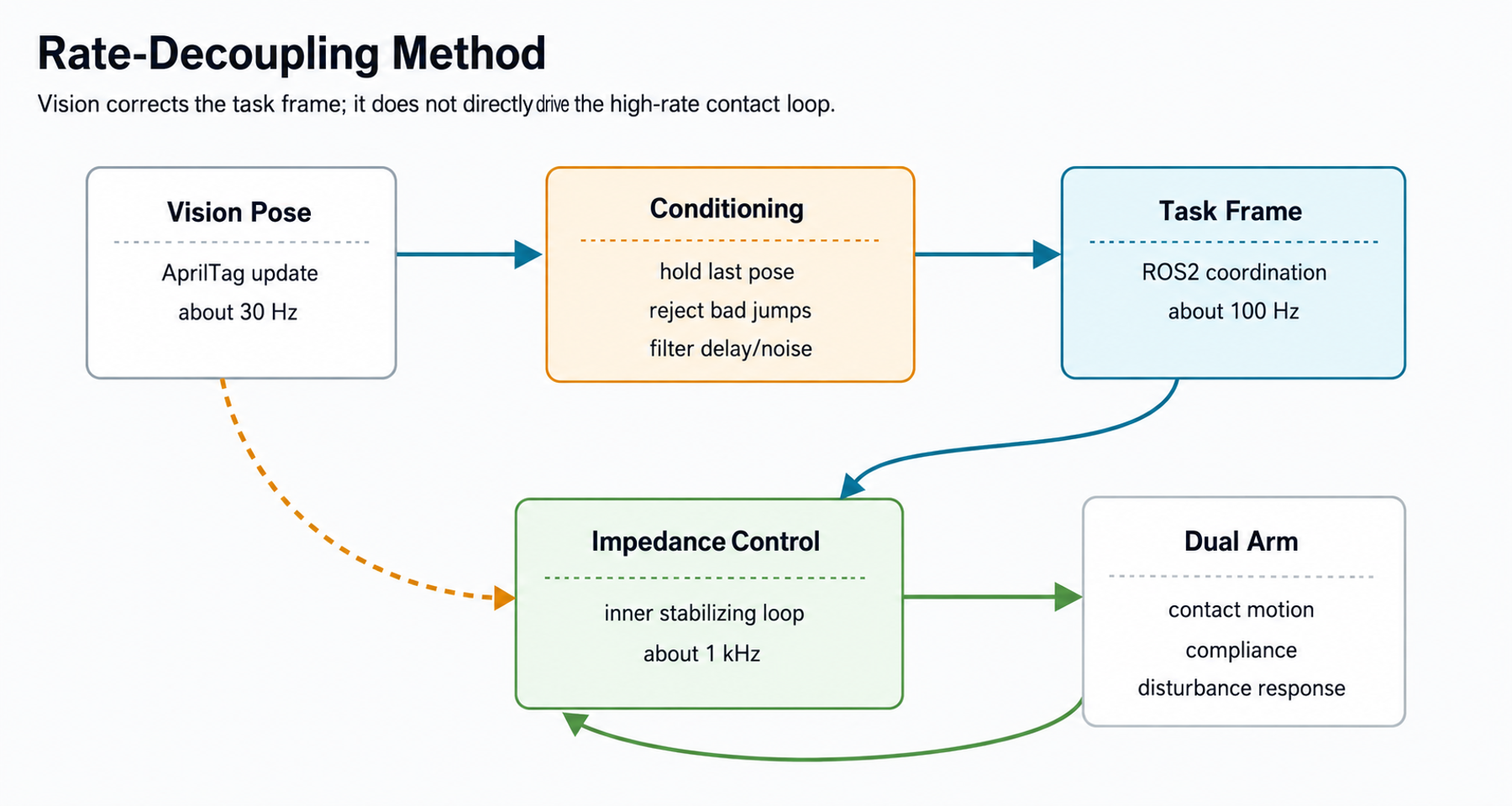
| Signal | Approximate rate | How it was used |
|---|---|---|
| AprilTag pose | 30 Hz | Task-frame correction under noisy or partial observations. |
| ROS2 coordination | 100 Hz | Dual-arm state and command synchronization. |
| Impedance loop | 1 kHz | Fast contact behavior, compliance, and disturbance rejection. |
Validation & Debugging
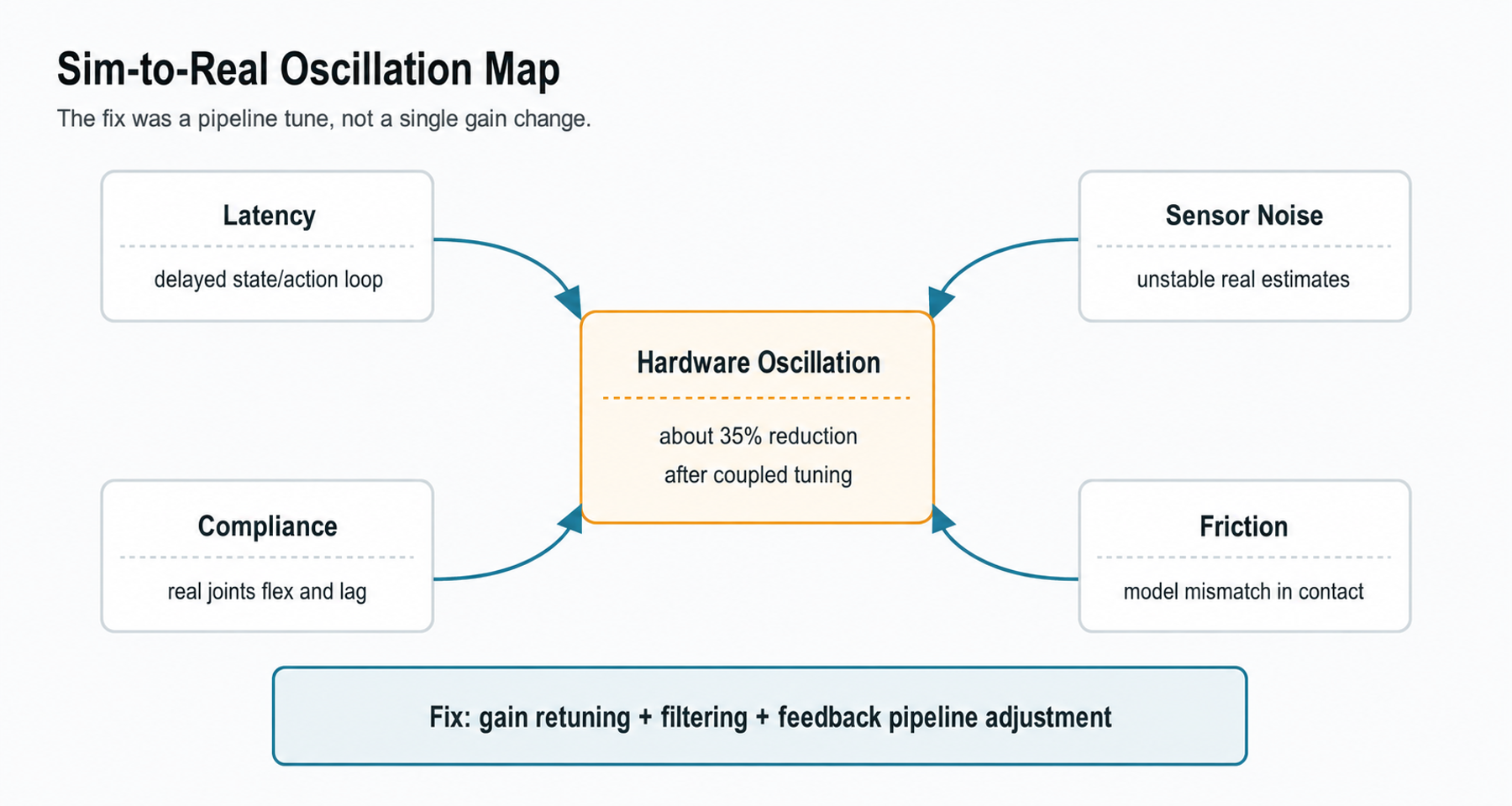
The largest debugging loop was sim-to-real control stability. Gains that looked stable in simulation amplified noisy or delayed real-state estimates on hardware. The fix combined gain retuning, filtering, feedback-pipeline adjustment, and explicit attention to latency, compliance, and friction.
Publishable result: real-hardware oscillation was reduced by about 35% after identifying latency, sensor noise, compliance, and unmodeled friction as coupled causes.
Evidence & Boundaries
| Safe to publish here | Needs Felix confirmation before adding |
|---|---|
| ROS2 dual-arm coordination at 100 Hz, 30 Hz AprilTag correction, 1 kHz impedance loop, about 35% oscillation reduction. | ACT policy metrics, DIGIT tactile benchmarks, whole-arm MPC metrics, VR teleoperation dataset details, and any customer or pilot specifics. |
What I Would Improve
Technically, I would keep separating signal rates even more aggressively: log every perception update, command timestamp, controller cycle, and contact event so the next tuning cycle can separate latency from compliance and friction. Strategically, the work taught me that robotics R&D is capital-intensive: technical progress can still be bounded by runway, team size, and the time needed to reach revenue or funding milestones.